Research of N32WB031
Research for the N32WB031 IC, why or why not to use it in the next project and some alternatives
Creating a project which requires Bluetooth and has to be low cost removes all the popular choices like nRF* from Nordic Semiconductor or chips from STM which are above 60 Kč. Because of that you might have stumbled upon this IC, which is one of the cheapest.
Product page: N32WB031 product page
Docs: EN_DS_N32WB03x.pdf
The documentation looks above average. It’s even available in English and there are a lot of docs which go over Hardware design and the API function guide.
Specs
Some quick specs just for reference:
| name | value |
|---|---|
| Full name | N32WB031KEQ6-2 |
| Package | QFN-32 (4x4) |
| Cost per one piece (lcsc 10pcs) | 14 Kč |
| CPU | 32-bit ARM Cortex-M0 |
| Maximum clock frequency | 64 MHz |
| Flash | 512 KB |
| SRAM | 48 KB |
| Operating voltage | 2.32 V to 3.6 V |
| Bluetooth | BLE 5.1 |
| BLE PHY | 125 kbps, 500 kbps, 1 Mbps, 2 Mbps |
| Radio receive sensitivity | -96 dBm @1 Mbps, -93 dBm @2 Mbps |
| Maximum transmit power | +6 dBm |
| Radio receive current | 3.8 mA @3.3 V |
| Radio transmit current | 4.2 mA @0 dBm/3.3 V |
| Operating current | 2.0 mA @64 MHz/3.3 V |
| Sleep mode | 1.4 μA @3 V, 48 KB SRAM retention |
| PD mode | 0.13 μA |
Quite impressive specs.
Dev board
The only dev board I could find for this IC is the N32WB031-STB Development Board.
I found it for the lowest price of 750 Kč + 100 Kč, which is a “little bit” overpriced, considering that all the parts are each just a few cents…
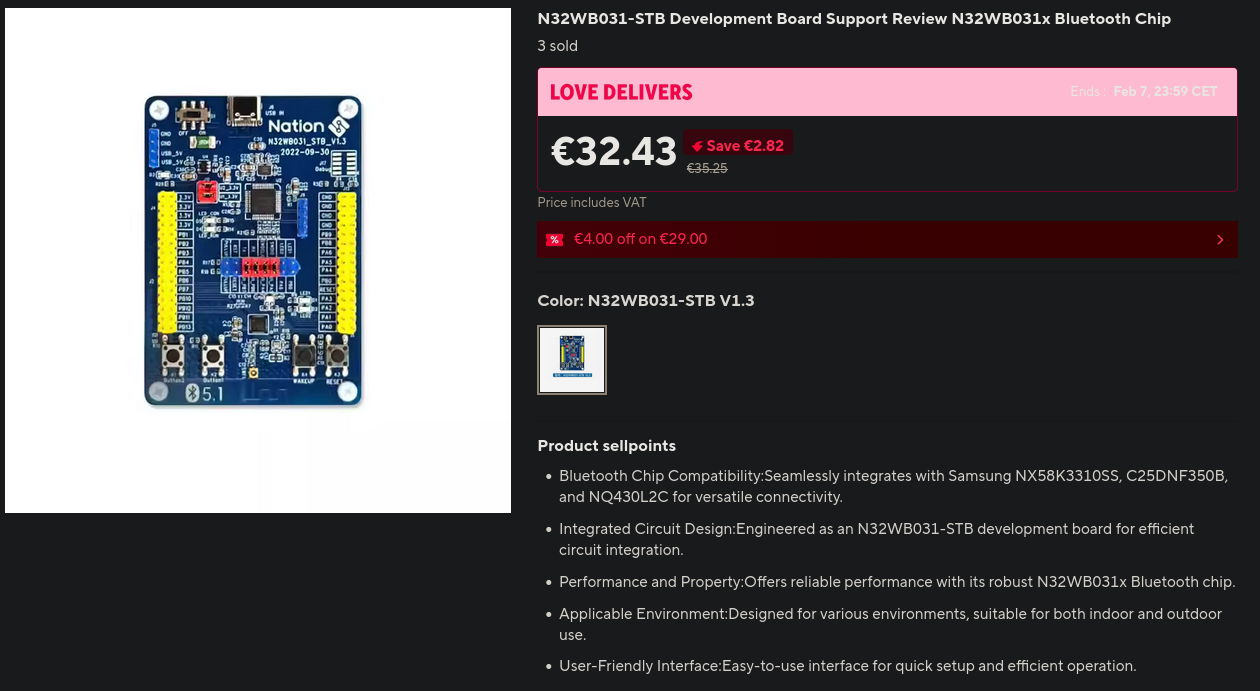
By some luck I also found a repo containing the board source files: N32WB03x-DK – Hardware Evaluation Board
But the schematic/PCB is in an older Eagle format which can’t be read by KiCad or any other tool I tried. The only way to open it seems to be using the paid version of Eagle. In some of the product images, there are images of the front/back PCB copper layers (including the antenna). So with a bit of effort it should be possible to recreate this dev board.
Software needed
Unfortunately, as every “smart” company does, they made their own proprietary, barely functional IDE… N32WB03x SDK User Guide
Better alternative CH592
The better alternative which I found is CH592.
Product page: CH592
This IC is from a fairly well-known company WCH (you probably already came across some of its products, CH340 is used on many Arduinos and it does USB <=> UART)
Some quick specs just for reference:
| Name | CH592X | CH592D |
|---|---|---|
| Full name | CH592X | CH592D |
| Package | QFN-32-EP (4x4) | QFN-20-EP (3x3) |
| Cost per one piece (lcsc 10pcs) | 17 Kč | 17 Kč |
| CPU | QingKe 32-bit RISC-V4C | |
| Maximum clock frequency | 80 MHz | |
| Flash | 512 KB | |
| SRAM | 26 KB | |
| Operating voltage | 1.7 V to 3.6 V | |
| Bluetooth | BLE 5.4 | |
| BLE PHY | 1 Mbps, 2 Mbps | |
| Radio receive sensitivity | -95 dBm | |
| Maximum transmit power | +4.5 dBm | |
| Radio receive current | 3.4 mA @3.3 V with DC-DC | |
| Radio transmit current | 3.5 mA @0 dBm/3.3 V with DC-DC | |
| Idle mode | 1.1 mA | |
| Halt mode | 180 uA | |
| Sleep mode | 0.8 uA to 2.5 uA | |
| Shutdown mode | 0.3 uA to 1.3 uA | |
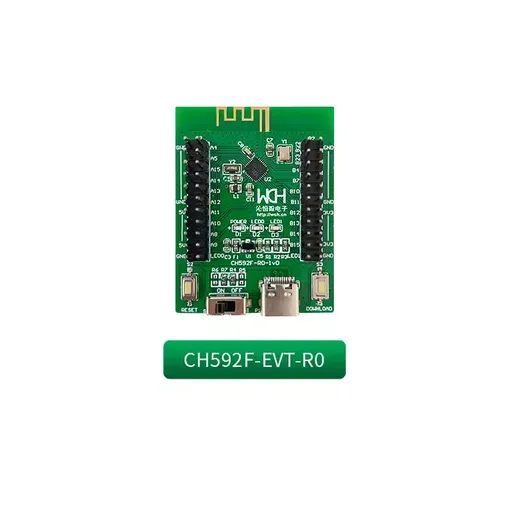
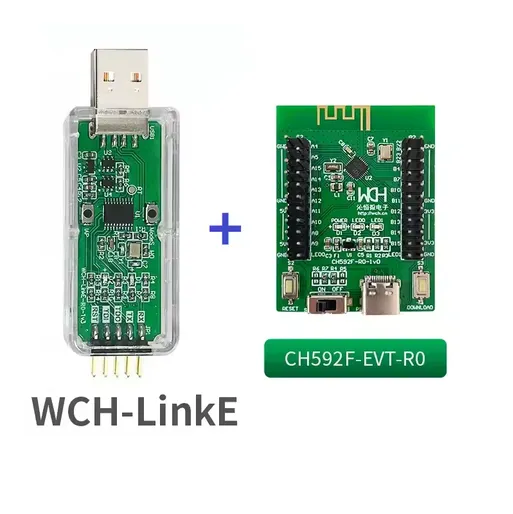
Dev board
Dev board is way cheaper, only 203 Kč.
Dev board with its programmer, WCH-LinkE, is 333 Kč.

Comparison
| name | N32WB031KEQ6-2 | CH592X | CH592D |
|---|---|---|---|
| Package | QFN-32 (4x4) | QFN-32-EP (4x4) | QFN-20-EP (3x3) |
| cost per one piece (lcsc 10pcs) | 14 Kč | 17 Kč | 17 Kč |
| cost per one piece (lcsc 100pcs) | 13 Kč | 13 Kč | 13 Kč |
| CPU | ARM Cortex-M0 | QingKe RISC-V4C | |
| maximum clock frequency | 64 MHz | 80 MHz | |
| operating voltage | 2.32 V to 3.6 V | 1.7 V to 3.6 V | |
| Bluetooth specification | BLE 5.1 | BLE 5.4 | |
| maximum BLE PHY speed | 2 Mbps | ||
| Radio receive sensitivity | -96 dBm @1 Mbps | -95 dBm @1 Mbps | |
| maximum transmit power | +6 dBm | +4.5 dBm | |
| Radio receive current | 3.8 mA @3.3 V | 3.4 mA @3.3 V | |
| Radio transmit current | 4.2 mA @0 dBm/3.3 V | 3.5 mA @0 dBm/3.3 V | |
| deepest low-power mode | 0.13 μA | 0.3 μA | |
| development board price | 850 Kč | 203 Kč | |
| development tooling | Keil MDK, vendor SDK, NS-Link | MounRiver Studio or GCC/Make, WCH-Link and community flashing tools | |
| community popularity | very low, scarce boards and few public projects | still niche, but noticeably more boards, guides and public projects | |
N32WB031 might be a little bit cheaper in a small quantity (10), but when approaching a small batch size (100) the price is nearly identical (a difference of a few cents). N32WB031 has some benefits like a lower power sleep mode or a little bit better transmit power, but in everything else the CH592 is winning.
CH592 is a more popular option with already existing projects, it has good documentation, tooling, and a dev board that’s way cheaper.
Conclusion
Due to the lack of popularity and based on all the specs, I would say the winner is CH592; development won’t be as painful as with using N32WB031.